 Voskis
Drying a full wash indoors without the damp
A washing machine hands you two to three litres of water along with the clean laundry. This page tells you where to put it, in what order, and which numbers to check.
11 September 2026
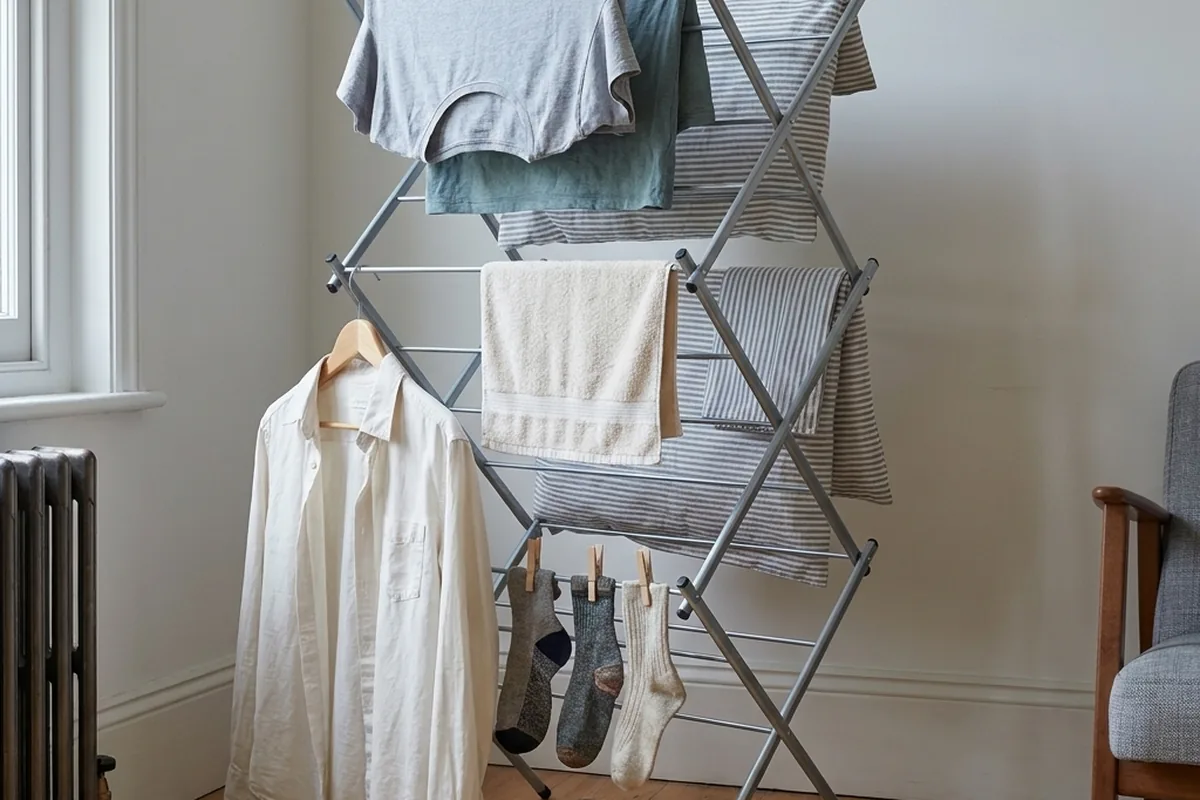
Where the water goes
An 8 kg drum takes a household wash of about 4.5 kg of dry cotton. Spun at 1400 rpm it leaves the machine holding 2 to 3 litres of water. Only evaporation removes that, and evaporation moves it into the air of the room.
Air has a ceiling: at 20 °C a cubic metre holds about 17 grams of water vapour. A 40 square metre flat with 2.5 m ceilings holds around 100 cubic metres of air — roughly 1.7 litres at saturation, less than one wash. The surplus condenses on the coldest surface in the room: the window, or the wall behind a wardrobe. Mould germinates on any surface that stays above 80 per cent humidity for days at a time. Manage the air, not the airer.
Spin first
The spin is the only stage that removes water without putting it into the room. Figures below are for that 4.5 kg load on an open airer, in a ventilated room at 20 °C.
| Final spin | Water left in the load | Rough time to dry indoors |
|---|---|---|
| 400 rpm (delicates) | 4.0 to 4.5 litres | 2 to 3 days |
| 800 rpm | about 3.2 litres | 24 to 36 hours |
| 1000 rpm | about 2.8 litres | 20 to 30 hours |
| 1200 rpm | about 2.5 litres | 16 to 24 hours |
| 1400 rpm | about 2.2 litres | 12 to 20 hours |
| 1600 rpm | about 2.0 litres | 10 to 16 hours |
Going from 800 to 1400 rpm removes about a litre, a third of the water, for a few extra minutes and a few cents of electricity. It is the largest single change you can make. A second spin adds another 100 to 200 ml in five minutes; run it on towels and denim.
High spin is not for everything. Wool, silk, elastane-heavy sportswear and anything with a low-spin symbol distorts or creases hard above 800 rpm. Spin those separately rather than dropping the whole wash to 800.
Load the airer for airflow, not capacity
Evaporation stalls when the film of air touching the fabric saturates. Moving air strips that film away; still air does not. Two towels hung touching dry at half the rate of the same two hung apart. Spacing beats surface area.
- One thickness only. A towel folded double over a rail seals two faces together and dries from the edges in. Hang it by one end, or across two rails.
- 3 to 5 cm of clear air between items. If two garments touch, move one.
- Heavy items on the outer rails, light items in the middle.
- Shirts and dresses on hangers, hooked over the top rail.
- Fill to about 80 per cent, and turn the load at six hours, centre pieces out to the edges.
Compare metres of line, not floor area. A concertina airer opening to 18 m of line takes a full wash at one thickness; Voskis stocks one.
Where to stand it
- Middle of the room, hard floor, clear air on four sides.
- Off external walls, corners and windows: the coldest surfaces, and where the water will condense.
- Not a bedroom you sleep in: you add moisture overnight and the walls cool.
- A small room with the door shut and a dehumidifier beats a large room with the doors open: a dehumidifier only works on air it can reach.
- A bathroom works if the extractor moves at least 15 litres a second, door shut and fan on. With no fan it is the worst room in the flat.
Ventilation, not heat
Heat speeds evaporation but removes no water: a warm sealed room holds more vapour until it meets a cold window and hands it back. Water leaves two ways, through an opening or into a dehumidifier tank.
Cold air is dry air once indoors. Air at 5 °C and 90 per cent humidity holds about 6 grams per cubic metre; warmed to 20 °C it reads roughly 35 per cent. An open window works in winter, however damp it feels outside.
| Method | Cost | When to use it |
|---|---|---|
| Window on the latch, doors open | €0; you pay in lost heat | Outdoors above about 10 °C, or the heating off |
| Dehumidifier, 150 to 300 W | 1.2 to 2.4 kWh over eight hours — about €0.30 to €0.60 | Cold weather, or no window you can leave open |
| Heating alone, windows shut | The dearest of the three | Never on its own. It removes nothing |
A dehumidifier pulls 1.5 to 2.5 litres out of a drying load and returns nearly all its input power as heat. Compressor models work best above 18 °C; desiccant models keep working in a cold room. Six to eight hours on a socket timer is enough — see extension leads and timers.
The numbers to check
- Room humidity under 60 per cent, ideally 45 to 55. A hygrometer costs a few euros.
- Above 65 per cent for days on end is the mould threshold — sustained readings, not one wet evening.
- Room temperature 18 to 21 °C, provided the water has a route out.
- Dew point at 20 °C and 60 per cent is about 12 °C. Any colder surface runs wet, and single glazing sits below it all winter.
Do not dry washing on a radiator. Covered, it loses 30 to 50 per cent of its output: the convection path is blocked, so the boiler runs longer for the same room temperature. The garment dries on its outer face and stays wet against the metal. Stand the airer 30 to 50 cm in front instead.
How long it should take
Spun at 1400 rpm, spaced properly, room at 20 °C and ventilated: 8 to 14 hours. Cold and still: 24 to 36. Nothing indoors dries in three hours.
Hang by 10 in the morning, turn mid-afternoon, and it is dry that evening or by breakfast. A load hung at 10 at night sits wet through the coldest, stillest hours. Still damp after 24 hours means the spin was too low, the spacing too tight, the room too cold, or the water had nowhere to go.
A musty smell means it dried too slowly
The smell is bacterial: fabric that stayed damp for more than about 8 to 12 hours at room temperature. No amount of conditioner or scent covers it.
Rewash it and dry it faster the second time. Do not iron it or put it away first — heat drives the smell into the fibres. For towels and bedding, a 60 °C wash with a powder containing bleach clears it in one cycle. Remove the causes too: out of the drum within an hour, door and drawer open between washes, an empty 60 °C cycle monthly.
Flats with no outdoor space
No balcony and no yard means every wash is an indoor wash: two to three litres a week into a fixed volume of air. Three things make it workable.
- Spin at 1400 rpm or above as standard. A litre goes before the load reaches the airer.
- Dry in one room with the door shut, and treat that room. A dehumidifier in a closed 12 square metre room clears a load overnight; in an open-plan flat it spends the night on the hallway.
- Ventilate after, not only during. Ten minutes with windows open on two sides loses less wall heat than a window cracked open all day.
Check the trickle vents in the window frames are open, and run the kitchen and bathroom fans 15 minutes after use. Never dry a wash in a room with no window and no vent: the water has no route out at all.
The routine, in order
- Low-spin items aside; spin the rest at 1400 rpm.
- Second spin on towels and denim.
- Hang within the hour, shaking each item out.
- One thickness, 3 to 5 cm apart, heavy pieces outside.
- Airer in the middle of the room, off the walls.
- Window on the latch, or dehumidifier six to eight hours, door shut.
- Hygrometer under 60 per cent. Turn the load at six hours.
- Ten minutes of wide-open ventilation once it is dry.
Ordering here is one short message, not a basket: see how to order and delivery and returns.