 Voskis
Extension leads and timers: what they can actually take
Work out what one socket will carry, add up what you have plugged into it, and set a timer so that it never switches something it should not switch.
11 September 2026
What 3680 W means
A domestic socket in most of the EU runs at 230 V and is rated 16 A. Multiply the two and you get 3680 W, the figure moulded into most extension leads, adaptors and timers sold with a Schuko plug. It is a ceiling, not a target. Two variations: Italian and older sockets rated 10 A, which is 2300 W, and UK-market equipment at 13 A, which is 3120 W. Read the lead itself, not the box: the rating is stamped near the plug or under the socket block.
The figure covers the whole lead at once: a four-way lead marked 3680 W gives four sockets sharing 3680 W, not 3680 W four times.
Add up what is plugged in
Every appliance carries a rating plate: back of a heater, base of a kettle, rim inside a washing machine door. Total the watts of everything on one lead that could run at once, and compare with the lead’s figure.
| Appliance | Typical draw | Notes |
|---|---|---|
| Kettle | 2200–3000 W | Full draw for two or three minutes |
| Fan heater or oil-filled radiator | 1000–2000 W | 2000 W on high, 1000 W on low |
| Iron | 2000–2400 W | Cycles on and off; count the peak |
| Tumble dryer | 2000–2700 W | Heat-pump models draw far less |
| Washing machine, heating | 1800–2200 W | First part of the cycle only |
| Hair dryer | 1500–2200 W | |
| Microwave | 1000–1500 W | Input, not the cooking power on the front |
| Toaster | 800–1500 W | |
| Vacuum cleaner | up to 900 W | Capped EU-wide since 2017 |
| Washing machine, washing and spinning | 150–400 W | Same machine, water already hot |
| Heated clothes airer | 200–300 W | |
| Dehumidifier | 200–500 W | |
| Fridge, compressor running | 60–200 W | Brief surge each time it starts |
| Electric towel rail | 60–150 W | |
| Television | 50–120 W | |
| Laptop charger | 45–90 W | Only while the battery is low |
| Phone charger | 5–25 W | |
| LED bulb | 5–10 W | |
| Router | 6–12 W |
Everything above the vacuum cleaner turns electricity into heat, and heat is what costs current. Below it sit electronics and small motors: a router, a television, two lamps and four chargers together come to about 250 W, seven per cent of the lead.
Failures happen at the top. A 3000 W kettle with a 2400 W iron is 5400 W, 47 per cent over the limit. A 2000 W heater with a 2200 W hair dryer is 4200 W. Two heat-producing appliances on one lead is the arrangement to avoid; one heater should have the socket to itself.
The lead is not the only limit. The breaker feeding a room is often 16 A as well and covers every socket in it, so moving the second kettle to another socket on the same wall adds nothing. A tripped breaker is reporting the total.
The hazard is not the number of sockets
A six-way lead is not more dangerous than a two-way lead. The hazard is a joint carrying more current than it was built for, and there are two ordinary ways to make one.
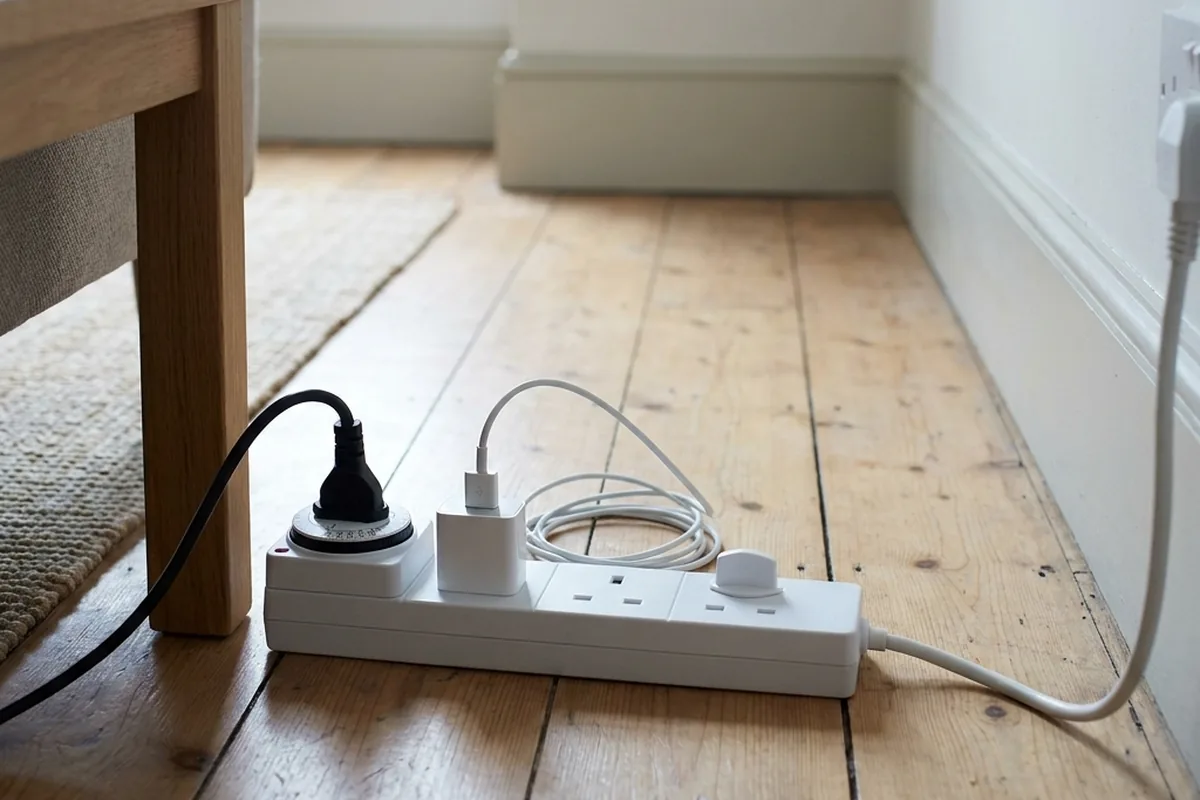
Daisy-chaining. Plug one lead into another and the load of every socket on both passes through a single plug and a single length of flex, the first one. Six sockets look like six allowances and remain one allowance of 16 A. Run one lead from the wall, with as many sockets as you need.
Stacked block adaptors. Two or three cubes pushed into each other hang off the wall as a lever. The weight tilts the assembly, the pins withdraw a millimetre or two, and the reduced contact area heats and arcs. Adaptors have no flex to spread the load and rarely carry a fuse. Use a lead on a cable instead.
Once a week, put a hand on the plug of whatever has run longest. Mildly warm is normal for a charger. Too hot to hold, brown discolouration around the pin holes, or a smell of hot plastic means that lead goes out of service today.
Cable, and unwinding the drum
The flex sets the real rating: 1.5 mm² for a full 16 A, 1.0 mm² for around 10 A, and 0.75 mm² for light duty only. The size is printed along the sheath every few centimetres.
Cable drums carry two ratings and mean both, typically 1200 W wound and 3680 W unwound. Coiled cable behaves like a coil: the turns heat each other, the heat has nowhere to go, and the insulation softens from the inside where you cannot see it. Unwind the drum completely before connecting anything above a few hundred watts, even when you only need three metres of it.
What surge protection does
A surge-protected lead clamps voltage spikes and diverts them to earth, which is worth having behind a television or a desk. It absorbs a finite quantity of energy, quoted in joules, and every spike spends some of it, so a protector five years into the job may now be an ordinary lead with a green light on it. Check the indicator occasionally, where the light means “still protecting”.
It does nothing about a power cut, does not hold voltage up in a brownout, and will not save equipment from a direct strike on the building. Unplug a computer in a storm anyway.
Mechanical or digital
| Mechanical dial | Digital | |
|---|---|---|
| Resolution | 15 minutes — 96 segments round a 24-hour dial | 1 minute |
| Programme | The same pattern every day | Usually 7-day, 8 to 20 on/off pairs |
| Setting it | Push the segments down, turn the dial to now | Set the clock, then each event by button |
| In a power cut | Stops and restarts, permanently behind by the length of the cut | Holds time on a backup cell for hours or days; past that the clock resets |
| Needs | Nothing. No battery, no clock chip, no app | A backup cell, charged by 12 to 14 hours plugged in |
| Typical rating | 16 A, 3680 W | Often 10 A, 2300 W — read the moulding |
On the dial each segment is a quarter of an hour, so the shortest instruction you can give is 15 minutes on, 15 minutes off. Line the current time against the arrow when you plug it in, and do the arithmetic after an outage: a two-hour cut leaves the timer two hours late until you turn the dial again. The side switch forces permanent on. The mechanical 24-hour timer Voskis stocks is rated the full 3680 W, so it carries whatever the socket carries.
Choose digital for a pattern that differs between weekdays and weekends, or where you need minute accuracy. Choose mechanical for the same pattern every day, and for a device with nothing in it to forget or flatten.
What to switch, and what never to
Reasonable uses:
- Table and floor lamps while you are away — two LED lamps from 18:30 to 23:00 is tens of watts and no heat.
- A plug-in towel rail on a fixed window, 06:00 to 08:00, where its instructions allow timer operation.
- Charging inside a cheaper tariff band: power tool packs, a cordless vacuum.
Never put a heating element on a timer that runs unattended. No fan heater, oil-filled radiator, halogen heater, electric blanket, iron, hair straightener, toaster, kettle or heated airer. Those appliances are designed to be switched on by a person who is in the room and stays there. A timer switches them on into an empty house, into a towel that has fallen across the grille or a chair moved yesterday. If a room must be warm at seven, use a heater with its own thermostat and tip-over cut-out, with somebody at home.
Three more to leave alone. A fridge or freezer: cutting the compressor short-cycles it and lets the contents warm. A washing machine or dishwasher: power removed mid-cycle strands the load in water, so use the machine’s own delay start. And anything someone depends on: medical equipment, an alarm, heating for a person who cannot reach the controls.
The timer’s rating governs everything downstream of it. A 3680 W lead plugged into a 2300 W timer is a 2300 W circuit with four sockets on it.
The check
- Follow each lead back to the wall. If it ends in another lead, rearrange.
- Count the block adaptors in the house. The target is zero.
- Read the rating on each lead, then the plates of what it feeds, and total them.
- Unwind any drum carrying a load.
- Confirm nothing with a heating element sits on a timer.
Damp laundry is the usual reason a household starts adding heaters and airers to one room; the lower-wattage methods are in drying a wash indoors. To have a rating checked before you buy, send the wattages to support.